Learns in simulation
No teleoperation data to collect for each task. Lexio complements imitation learning on structured, repeatable tasks.

 EN
Physical AI · Built in Europe
Lexio’s engine trains your robot in simulation, using the 3D model of your part. Once the skill works there, it runs on your real robot. No programming, no human demonstrations.
Our approach
Built to work with large AI models trained by imitation, not against them: they can run inside our engine, and our skills can help train them.
How the technology works
Inputs
Lexio skill engine · in simulation
Simulator-agnostic
Output
Skill libraryeach skill speeds up the next
Same task, three set-ups
The same end-of-line task on a stamping line, solved for three set-ups: two robot brands, a two-finger gripper and a suction cup.
No teleoperation data to collect for each task. Lexio complements imitation learning on structured, repeatable tasks.
Integrators deploy new tasks faster. Operators switch to a new part reference without calling an integrator.
One engine across robots, grippers and simulators. Get more from the robots you already have, or choose the one that fits the job.
Validated on real hardware
Skills found by our engine have been transferred from simulation to real robots, across very different hardware.
Work with us
Know which tasks to robotise, and with what hardware, before you invest.
Learn moreA robot skill for each new part or task, on your hardware, with no programming.
Learn moreAlready decided to robotise a specific use case? Lexio speeds up its deployment.
Talk about your use caseUse cases
The same engine at work on very different industrial tasks.
Metal fabrication
Bending sequences and robot motions for each new part on a robotic press brake, without hours of programming.
Manufacturing, electronics
The robot presents every face of each new part to the cameras, with no dedicated fixture per reference.
Machining
A new part reference handled without calling a robot programmer.
Metal production
Parts picked at the end of the line and placed in racks or containers, for every new reference.
Biotech R&D
A bench robot runs a new protocol after a short set-up, with no code.
Energy, electronics
Each cell placed in the tester, measured, then sorted pass or fail.
European deep tech
Our engine is modular: each skill combines identifiable modules and is validated in simulation. This design is built for explainable physical AI, and to leave industrial groups in control of their data.
Our goal: to become the reference skill engine for industrial robots, worldwide.
Our story
Lexio Robotics began at ISIR, the robotics lab of Sorbonne University and CNRS, where our founders pioneered the use of evolutionary algorithms to teach robots how to move, adapt and learn. Four years of public research later, we are turning that work into an engine for industry.

Cofounder, CEO
PhD in robot learning from Sorbonne University, with highest honours. He pioneered quality-diversity algorithms for robot manipulation and has been distinguished in several university eloquence contests.

Cofounder, CTO
PhD from Arts et Métiers and AI engineering degree from CentraleSupélec. He developed advanced AI models for natural human–robot collaboration. Passionate about physical AI, he turns research into real-world impact.
Latest news

More than 120 startups from around the world competed, with technologies chosen for their impact on automotive production. Lexio Robotics won the Industry 5.0 & Robotics category.
The prize was presented at the Mondial de l’Auto in Paris by Stellantis and PFA, who funded the competition and selected the winners in this category.
Photo: Louis Westerloppe
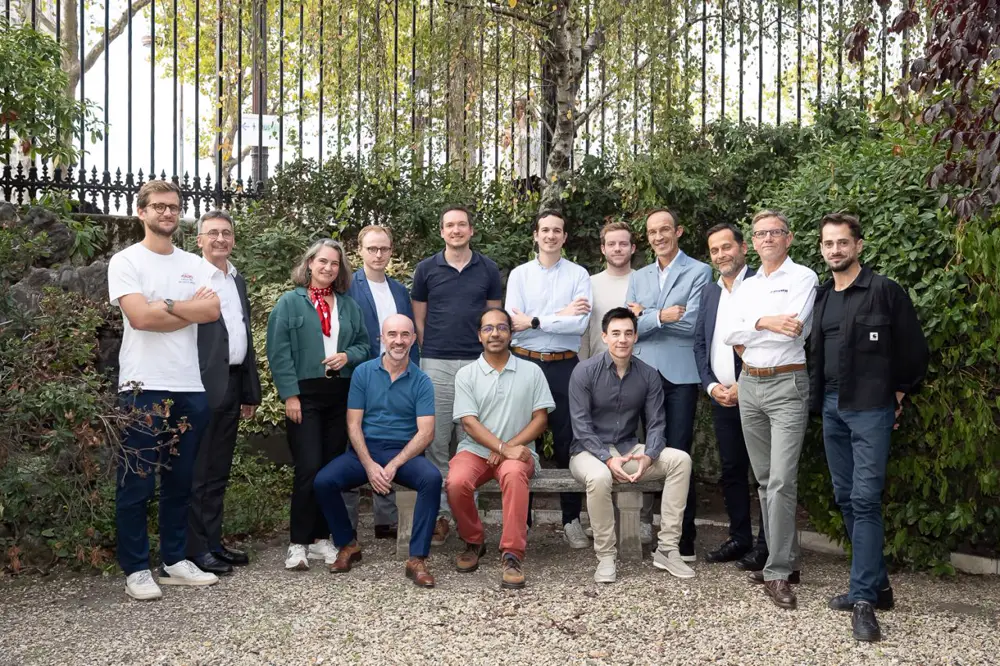
The accelerator of the French automotive industry selects and supports startups with strong potential for the sector.
It connects them with international groups such as Renault Group and Stellantis.
Research
 Born at Sorbonne University Our technology was born at ISIR, the robotics lab of Sorbonne University, during four years of public research by our founders.
 Research with CNRS ISIR is a joint lab of Sorbonne University and CNRS, France’s national centre for scientific research.
Supported by France 2030
 Supported by France 2030 Lexio Robotics is supported by France 2030, the French State’s investment plan for innovation and industry, through the i-PhD competition.
 i-PhD laureate 2025 Laureate of i-PhD 2025, the national deeptech competition for doctoral research, run by the French Ministry of Research and Bpifrance.
Incubation & acceleration
 Incubated at Agoranov Lexio Robotics is incubated at Agoranov, the Paris deeptech incubator where Criteo, Doctolib and Alan got started.
 Accelerated by Wilco Lexio Robotics is accelerated by Wilco, one of the leading startup accelerators in the Paris region.
 Accelerated by the Automotive Lab Since October 2026, Lexio Robotics is part of the Automotive Lab, the accelerator of the French automotive industry, run and funded by PFA.
Careers
If you work on robotics, simulation or machine learning and want to put research on real robots, we would be glad to hear from you.
Send a spontaneous applicationNext step
Industrial groups, robot makers, investors: we’d be glad to hear from you.